Support Automation #3433: Expense Tracking with Intercom + HubSpot + Elasticsearch
Apps involved:
IntercomHubSpotElasticsearch
Part of the Customer Experience strategy guide.
Problem
High-volume expense tracking queues in Intercom stall when downstream updates to HubSpot are manual.
Automation standardizes triage and notification for the support stack.
Workflow
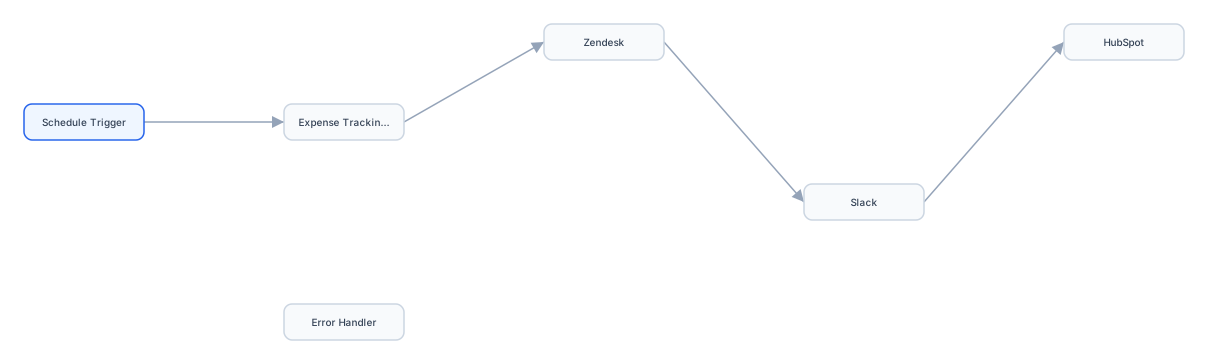
Intercom ticket event → classify/priority rules → update HubSpot → ping channel in Elasticsearch.
Tools Used
- Intercom
- HubSpot
- Elasticsearch
Setup Steps
- Connect Intercom and HubSpot with scoped API permissions.
- Configure the expense tracking entry condition (Hard difficulty in this library entry).
- Set field transforms and default values between tools.
- Add a dead-letter or retry path for failed runs.
- Validate with sample data before go-live.
Expected Outcome
- expense tracking runs without manual copy-paste between Intercom, HubSpot, Elasticsearch.
- Status updates stay aligned across the connected tools.
- Failures surface in one place instead of silent drift.
Benefits & ROI
- Ranked as High ROI in our template dataset for Support.
- Typical implementation complexity: Hard.
- Frees ops time from repetitive expense tracking tasks in this stack.
Variations
- Add a manual approval step before writes to HubSpot.
- Insert a deduplication check on Intercom record IDs.
Troubleshooting
- Test reopened tickets to avoid duplicate threads.
- Map priority and assignee fields explicitly.
- Rate-limit high-volume webhook bursts from the helpdesk.
Free Resource
Steal Our Top 10 Automation Blueprints for 2026
Get the exact tool stacks and logic diagrams used by top ops teams to save 10+ hours a week. Delivered instantly.
Zero spam. Unsubscribe anytime.
Continue Reading
Unlock Your Team's Automation Potential
Get a professional Strategy Audit. We'll identify your 3 biggest automation bottlenecks and how to fix them.