Support Automation #3825: Asset Tracking with OpenAI + Slack + HubSpot
Apps involved:
OpenAISlackHubSpot
Part of the Customer Experience strategy guide.
Problem
Agents switch between OpenAI and Slack to complete asset tracking, which slows resolution and fragments ticket history.
Connecting the tools keeps customer context in one thread.
Workflow
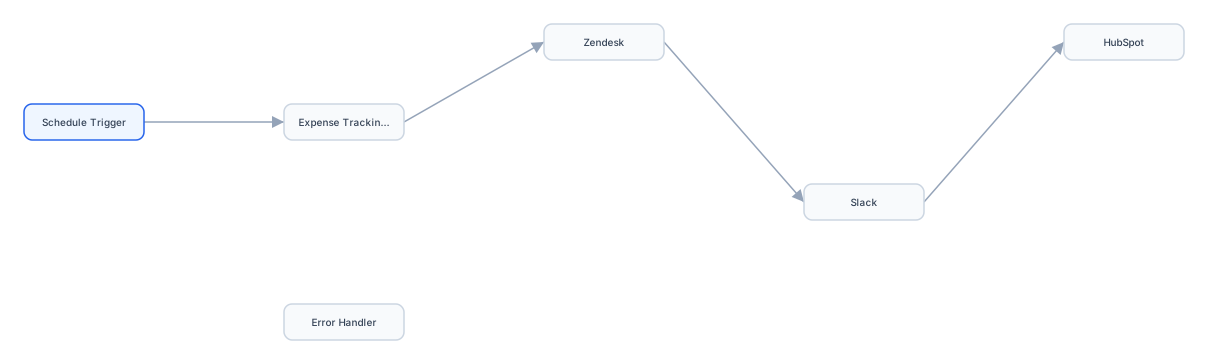
OpenAI ticket event → classify/priority rules → update Slack → ping channel in HubSpot.
Tools Used
- OpenAI
- Slack
- HubSpot
Setup Steps
- Create credentials for OpenAI, Slack, HubSpot in your orchestration platform.
- Define the asset tracking trigger in OpenAI.
- Map required fields from OpenAI to Slack.
- Add error handling appropriate for a Hard workflow.
- Run a test payload, then enable production execution (~37 min typical setup in our dataset).
Expected Outcome
- A repeatable asset tracking path for support teams.
- Less context switching between OpenAI and Slack.
- Easier hand-offs for the next ops owner.
Benefits & ROI
- Library metadata: High ROI tier · Hard difficulty · ~37 min setup estimate.
- Reduces manual asset tracking steps between OpenAI, Slack, HubSpot.
- Provides a baseline you can extend with approvals, logging, or QA gates.
Troubleshooting
- Confirm ticket status enums match between helpdesk and downstream tools.
- Test reopened tickets to avoid duplicate threads.
- Map priority and assignee fields explicitly.
Free Resource
Steal Our Top 10 Automation Blueprints for 2026
Get the exact tool stacks and logic diagrams used by top ops teams to save 10+ hours a week. Delivered instantly.
Zero spam. Unsubscribe anytime.
Continue Reading
Unlock Your Team's Automation Potential
Get a professional Strategy Audit. We'll identify your 3 biggest automation bottlenecks and how to fix them.